
Click on the image below to enlarge
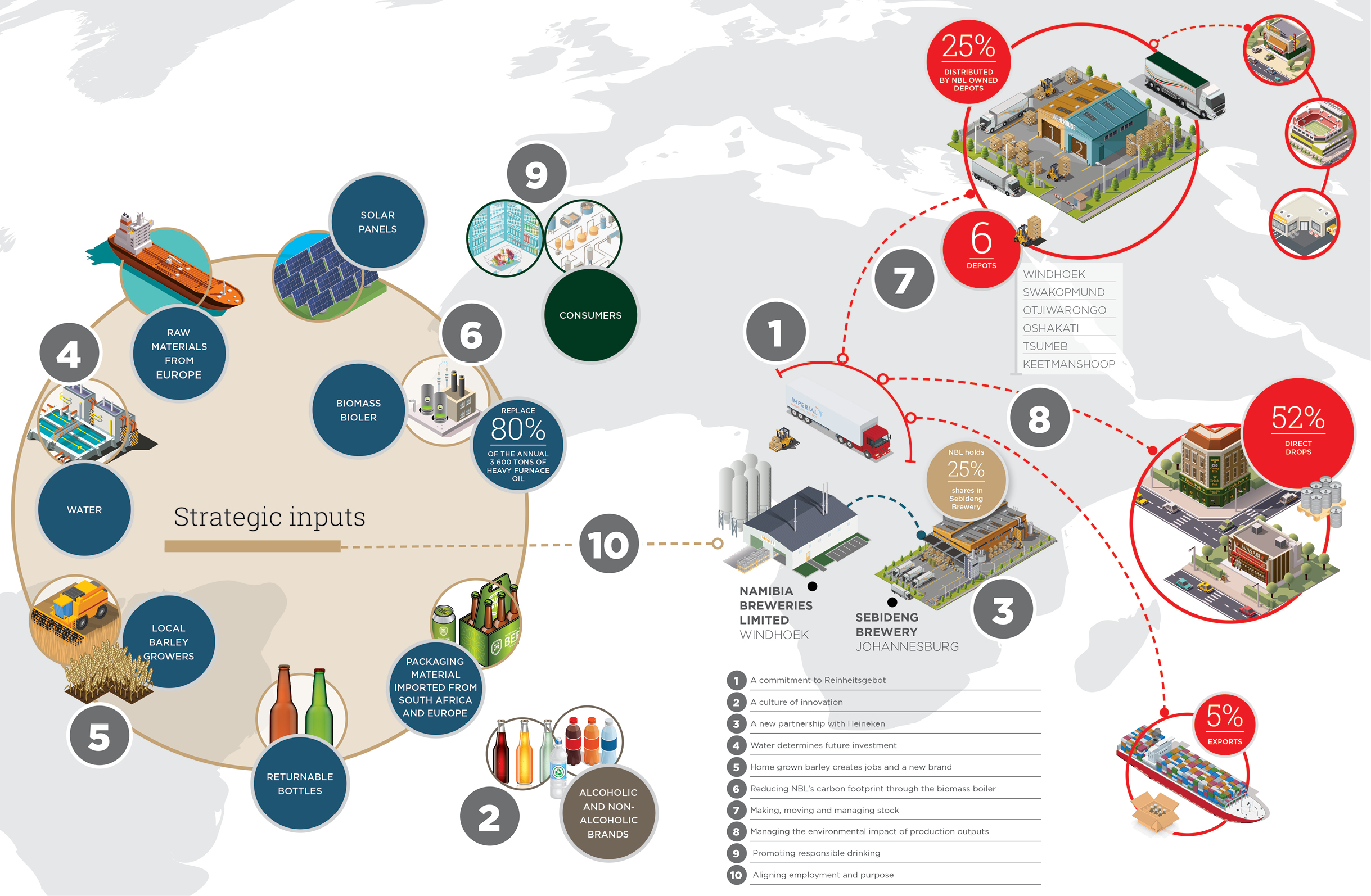
NBL is predominantly dependent on imported raw material for the production and packaging of its beverages. Packaging material, which includes bottles, cans, cartons and shrink foil is imported from South Africa, whereas raw ingredients are imported from Europe (mainly Germany and Holland).
Strategic and long-standing relationships with European suppliers ensure sustainable supply, even during constrained availability, as proven during Europe’s poor harvest last year. The procurement of a major portion of ingredients are based on long-term contracts – some running three to four years into the future – to ensure the required volumes and quality. When the exchange rate impact is excluded, pricing on these contracts remained constant over the past year.
NBL is actively exploring options to develop local supply, such as the barley and crates from local suppliers. Options to develop local packaging suppliers for crates and crown corks are underway.
Distribution partnerships
NBL owns six depots in Namibia from where it supplies the formal and informal market, with the rest being direct drop shipments to a variety of other customers. All primary transport is outsourced to strategic partner Imperial Managed Logistics Namibia (Proprietary) Limited (IML), whereas secondary distribution (between depots and customers) is done by NBL trucks and employees.
Secondary distribution customers typically include supermarkets, liquor stores, shebeens, pubs and other hospitality outlets. By owning this section of the logistics chain, NBL retains the direct customer relationship and interaction. This also enables NBL to offer allowances that incentivise customers to use hand offloading which, in turn, creates job opportunities.
Exports are handled through a combination of sea freight and trucks – the Company continuously evaluates its route to market options to ensure cost-efficiency.
IML is a Namibian company and does not own any trucks – this is outsourced to small transport companies of which more than 50% have previously disadvantaged owners. More than 80% of loads in Namibia are handled by previously disadvantaged owners.
The partnership with IML allows NBL to better manage the peak season, which sometime entails the distribution of double the normal volumes. IML also schedules according to a transport management system that ensures optimum return loads, especially from South Africa.
Continuous improvement
The return of empty 500-ml and 750-ml returnable bottles forms part of transport logistics. During 2016 a 16% improvement efficiency was achieved by implementing a new truck stacking mechanism for pallets containing empty, returnable bottles. The new stacking resulted in faster turnaround time, thereby reducing the return to factory cycle, which has a positive impact on working capital.
Since February 2015 NBL also has an agreement with competitor SABMilller Namibia to partner on returnable bottles in Namibia – weekly exchanges of each other’s returnable bottles take place.
The SAP warehouse management system will be implemented in the next year, to include all stock, bins, loading, picking and other related activities. This will assist in optimising planning, which include a growing number of new stock keeping units.
Read more about new products in the section on innovation.
To address the challenge of increasing units, increased floor space was created with the implementation of a racking programme at three facilities. Continuous improvement and excellent service are the outcomes of highly committed employees at all NBL depots, who deliver on the strategic objective to Producing Breakthrough Everywhere.
