
Sub-Saharan Africa offers a mixed set of opportunities and challenges, with overall economic activity weakening. According to the International Monetary Fund the region’s growth prospects are decelerating to 3%, well below the average 5% – 7% of the past decade. This has been driven primarily by a decline in commodity demand, which resulted in downward price pressure. Lower oil exports, the Ebola epidemic, widespread droughts, exchange rate volatility and political instability remain high on macro-economic agendas.
In several countries growth is supported by on-going infrastructure investment efforts and strong private consumption.
Namibia overview
Namibia’s expected GDP growth rate of 4.3% for 2016 is limited by factors such as its economic interdependency with South Africa, water restrictions and droughts, the increasing cost of electricity and municipal services, a weakening exchange rate, rising interest rates and increased competition.
Social challenges include the unavailability of skills and business experience, which contributes to continuing high levels of unemployment and poverty.
The last Namibian census was conducted in 2011 with data released in 2013 and 2014. According to the census, half of Namibia’s 2.1 million adult population is aged below 24 years. The median age is 21 years, which is considered ‘young’ by international standards.
According to the Namibia Liquor Act, 1998 (Act No. 6 of 1998), sales of liquor to any person under the age of 18 years are not permitted.
South Africa overview
South Africa is expected to achieve a low GDP growth rate of 0.2% in 2016. Political uncertainty has led to low investor confidence and the threat of a downgrade of the country’s sovereign credit rating to junk status.
Widespread droughts impact food prices, and along with the volatility of the Rand, constitute a key driver of inflation as interest rates rise. Consumers are under severe pressure and social unrest is increasing as the country nears municipal elections in August 2016.
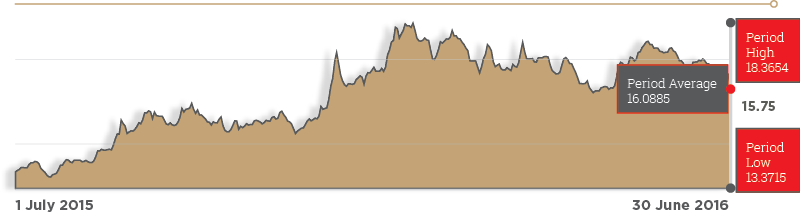
The South African Rand exchange rate (to which the Namibia Dollar is linked) deteriorated over the financial year, and remains volatile. The graph that follows shows the trend against the Euro over the year.
The South African Rand exchange rate
“The global brewers have outperformed the MSCI Global index by c. 300% in the past 10 years, driven in no small part by the large amount of revenue and cost synergies (from consolidation) that have accrued to shareholders over time.” – Coronation Corospondent, January 2016
The brewing category has high barriers to entry, and competition is predominantly based on brand power, scale and distribution. The benefits of size continue to drive consolidation globally and regionally. Competition from emerging craft (micro) breweries is a fairly recent trend in South Africa, and still very limited in Namibia.
Beer consumption trends
Africa is set to maintain its pace as the fastest growing global beer market, according to Canadean’s Global Beer Trends report published in October 2015.
Africa is predicted to achieve an average growth rate of 5% per year from 2015 to 2020, ahead of Asia which is expected to grow at an average rate of 3% per year during the same period.
Internationally, craft beer has become one of the most attractive growth segments in beer. Craft offerings are artisanal products that often support local communities and provide an authentic experience through premium ingredients, unique flavours and small-batch quality. Even bigger, commercial brewers are entering this category by investing in craft-style brands or acquiring craft breweries.
‘Craft’ and ‘craft-styled’ beer is estimated to be close to 5% of total beer volume in South Africa with double-digit growth rates expected.
According to research done by Goldman Sachs on ‘The Rise of Craft’, the millennial generation, who represent the largest age cohort in the world, are more experimental, seek bolder flavours, and have a high propensity for things that are perceived to be more ‘authentic’ – requirements which are well met by the craft beer category with its small, differentiated and unique offerings.
High-end consumer food preferences are also increasingly weighed towards local and high quality offerings, which are aligned to the craft beer offering.
NBL’s consumer research in their home market indicated that consumers want choice and are becoming less loyal to a specific brand. They want to portray themselves through what they drink, which therefore has to be relevant to their lifestyle. Taste is becoming less important – status is the most prominent driver.
International brands are gaining a foothold in the market, offering a wider range of offerings – and consumers are willing to experiment. Health awareness is leading to growth in non-alcoholic categories with lower sugar. With increasing urbanisation, the consumption of traditional drinks is declining and categories such as ciders and wines are growing.
