
partnering
managing director’s report
for growth
Overview
NBL delivered excellent results for 2016, growing operating profit and Namibian beer volumes by 6.7% and 8% respectively. These results were achieved despite continued macro-economic challenges, volume migration to South Africa and exchange rate impacts.
Our performance was the direct result of employees taking ownership and bringing our purpose to life: Creating a Future, Enhancing Life. As each employee finds their individual purpose and their connection to the Group purpose, we see exponential contributions to the business and to Namibia in total. We made performance personal this year: we brought a sense of urgency, speed of execution, innovation and breakthrough intent into all our conversations.
The exchange rate shock of the past two years, combined with direct competition in our home market, took the business out of its comfort zone and created a virtual crisis. This brought us to breakthrough leadership, which has made a significant impact on how we do business – with excellent results.
Performance summary
Revenues decreased by 0.3% for the year. Namibia beer volumes increased by 8%, driven predominantly by Tafel Lager sales which, for the first time, achieved more than 1 million hectolitres in 12 months (a significant contribution to total Namibian beer volumes). Beer volumes shipped to South Africa decreased by 43% due to volumes migrated to Sedibeng as part of the new Heineken agreement.
Export beer volumes (excluding South Africa) decreased by 5%. NBL’s sales strategy in export markets is differentiated according to the market’s denomination as a focus or trading market. Focus markets include Tanzania, Mozambique, Zambia and Botswana: markets with high growth potential and therefore earmarked for in‑market presence and investment. Tanzania doubled volumes year‑on‑year for the third consecutive year and continues outperforming expectations. Botswana managed to halt an initial decline in volumes through pack renovation and competitive pricing. Mozambique disappointed and Zambia remains challenging due to currency devaluation.
|
We are building sustainable structures, driving execution and building direct relationships through our in-country employees in these focus markets. |
Revenue
N$2.4 billion
( 0.3%)
0.3%)
Tafel Lager
> 1 million hectolitres
in 12 months
We are building sustainable structures, driving execution and building direct relationships through our in-country employees in these focus markets. In the past year there were new Windhoek Draught pack sizes launched in Mozambique and Botswana while Vigo is a strategic focus in Zambia and Botswana.
In the long term we aim to create economies of scale in these regional markets to be able to manufacture in-market, thereby reducing transport and other costs, which are negatively impacting our ability to achieve competitive prices. At the moment the fact that NBL does not have returnable volumes also counts against us from a volume and cost perspective.
Trading markets include, for example, the United Kingdom, Germany and Australia where expat communities and tourism exposure to Namibia are driving demand. Volumes in trading markets remained flat but we are committed to drive these as part of our growth strategy.
Salient features
 |
Namibian beer |
|
Operating |
|
Basic earnings |
|
Headline |
|
Full dividend |
Financial results
| Consolidated statements of comprehensive income |
30 Jun |
30 Jun |
||
| Turnover | 2 425 885 | 2 434 177 | ||
| Operating expenses | (1 885 211) | (1 927 663) | ||
| Operating profit | 540 674 | 506 514 | ||
| Finance costs | (39 412) | (8 847) | ||
| Finance income | 18 315 | 22 000 | ||
| Equity loss from joint venture (ongoing operations) | (38 917) | (124 593) | ||
| Equity loss from associate (ongoing operations) | (61 759) | – | ||
| Equity income from associate (deferred tax asset write-back) | 89 212 | – | ||
| Profit before income tax | 508 113 | 395 074 | ||
| Income tax expense | (135 643) | (136 092) | ||
| Profit attributable to ordinary shareholders | 372 470 | 258 982 | ||
| Consolidated statements of financial position | ||||
| Property, plant and equipment | 983 365 | 871 133 | ||
| Investment in joint venture | – | 28 325 | ||
| Investment in associate | 610 526 | – | ||
| Non-current assets held for sale | – | 4 500 | ||
| Other non-current assets | 25 530 | 16 762 | ||
| Current assets | 850 796 | 816 429 | ||
| Total assets | 2 470 217 | 1 737 149 | ||
| Issued capital | 1 024 | 1 024 | ||
| Foreign currency translation reserve | 249 | (3) | ||
| Retained income | 1 256 521 | 1 043 078 | ||
| Ordinary shareholders’ equity | 1 257 794 | 1 044 099 | ||
| Interest-bearing loans and borrowings (non-current) | 479 739 | 13 821 | ||
| Other non-current liabilities | 212 949 | 207 274 | ||
| Current liabilities | 519 735 | 471 955 | ||
| Total equity and liabilities | 2 470 217 | 1 737 149 | ||
MALT, which is imported from EUROPE,
is NBL’s single biggest cost element.
|
Our performance was the direct result of employees taking ownership and bringing our purpose to life: Creating a Future, Enhancing Life. |
Turnover decreased by 0.3% to N$2 425 million (2015: N$2 434 million) mainly due to a decrease in volumes migrated to Sedibeng.
NBL’s operating profit (before equity losses) increased by 6.7%. The Group’s cost base benefited from favourable price variances for raw materials and packaging materials which supported the growth in operating profit.
One of NBL’s cost realities is the fact that all machinery and the related repairs and maintenance services are imported, and therefore subject to the exchange rate. We continuously expand our technical expertise to do as much internal line maintenance as possible.
Malt, which is imported from Europe, is NBL’s single biggest cost element.
38% of commodities was sourced locally, exceeding the target of more than 30% by 2019. We also continue to reduce packaging material losses, which was 1.51% compared to 1.95% in 2015.
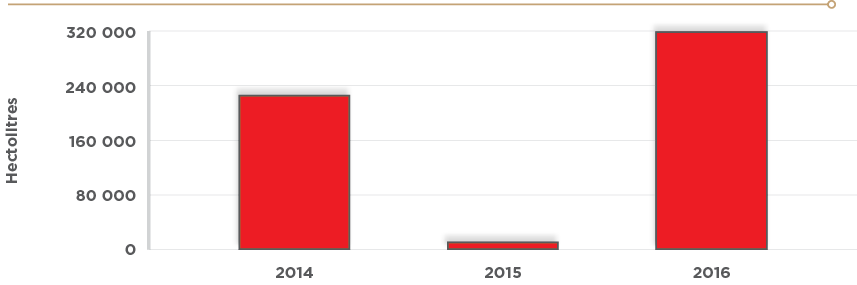
During the year, the production of 320 000 hectolitres of beer was migrated to Sedibeng, which affected unit cost performance in Namibia.
Profit after tax increased by 43.8%, mainly due to the deferred tax write back in the current year. In 2013, the Group recognised a full write-down of its portion (15.5%) of the deferred tax asset in Heineken South Africa (Proprietary) Limited (formerly known as DHN Drinks (Proprietary) Limited, amounting to N$188.1 million. During the current year, after the restructuring, the Directors consider, that at year end, a portion of the N$1.6 billion assessed loss in Heineken South Africa (Proprietary) Limited is recoverable and have therefore included an amount of N$89.2 million, being its share of the deferred tax asset included in the Heineken South Africa (Proprietary) Limited accounts.
Migration of beer production volumes from Windhoek to Sedibeng
DHN Drinks has been a loss-making entity for the past 9 years, attributed to a fiercely competitive environment in South Africa and higher cost of goods sold per unit. NBL earned royalties from the joint venture. A total of N$49.7 million and N$38.9 million was earned in royalties from DHN Drinks and Heineken South Africa respectively in the current year.
Profit attributable to shareholders of N$372 million was delivered – an increase of 43.8% on the prior year.
NBL’s net debt to equity ratio increased to 26% (2015: -14 %) following the restructuring of the South African operations.
On 1 December 2015 the Group acquired 25% of the issued share capital of Sedibeng and an additional 9.5% of the issued share capital of DHN Drinks from Diageo Holdings B.V. DHN Drinks was responsible for the sale, marketing and distribution of international beer and RTD brands whereas Sedibeng carried on the business of manufacturing these brands and providing these exclusively to DHN Drinks for distribution in the relevant markets. The total investment amounted to N$611 million, which impacted total loans and borrowings, gearing and interest cover. A total of N$500 million was raised from interest-bearing borrowings, which was partly used to fund the restructuring of the South African joint venture (N$200 million) and partly for operational costs (N$300 million).
Net cash flows from operating activities decreased to N$357 million (2015: N$466 million) due to reduced revenue and increases in working capital requirements. Net cash outflow from investing activities increased – mainly due to the purchase of shares in the associate and increased capital expenditure. Net cash flow from financing activities increased to N$347 million (2015: N$4 million) mainly due to the N$500 million loans raised during the year.
Read more about financial risks in the annual financial statements.
Marketing and brand performance
Our customers and consumers remained at the heart of our marketing and innovation agenda. This means that all decisions were based on our strategic intent to deliver consistent experiences with lasting impact. As a result, our portfolio is expanding into new non-alcoholic categories, providing more options for people who ask for healthy and authentic choices.
Our marketing strategy has two pillars
- Growing our share of beverage
- Delivering growth through scalable innovation
A highlight for the past year was the launch of King Lager as a combined business and social development initiative. The new beer expands NBL’s portfolio while driving the development of local barley growing, which creates jobs and results in economic empowerment within the agricultural sector. It is also a good example of how strategic partnerships between business and Government can deliver on common goals.
We also launched McKane Lemonade and Amstel Lite and increased trading in the mainstream water category with AquaSplash, which NBL acquired from O&L subsidiary, Namibia Diaries in 2015.
NBL has strengthened its strategy to position itself in the craft beer market.
In Namibia, our marketing and sales initiatives are directed by creating great consumer brand experiences, for example McKane’s campaign to crown the first Namibian master of mixology. We continue leveraging the power of digital to entrench our connections with consumers and work hard at being our suppliers’ most trusted business partner of choice.
As always, we consider every product launch, promotion and campaign against the requirements of the SAIF’s code of conduct to ensure responsible consumption.
Read more about our responsible drinking initiatives.
Strategic risks and opportunities
Strategic risks currently include
- Continued foreign currency fluctuation, which poses exchange rate risks – we are exploring markets which provide exchange hedging, reduce operating expenses and continue developing local supply.
- Political and social instability in the region negatively affecting investor confidence – we engage with Government and investors to ensure that there is a solid understanding of our strategy and growth opportunities.
- Regional water shortages due to climate change and ageing infrastructure – we have developed water supply scenarios for NBL with different trade-offs and decisions based on the outcomes of our discussions underway with local and national authorities.
- Loss of beverage market share due to changing brand loyalty and consumer trends – we track market and consumer insights in combination with business planning analyses to develop proactive responses and options.
- Inability to retain and attract skills in Namibia, combined with limited availability – we are reviewing our remuneration model, including reward and recognition best practice options.
The South African beer market remains NBL’s biggest growth opportunity in the short term. South Africa is one of the biggest beer markets in the region, with beer volume growth projected to be approximately 1.5% per annum, from its current 30 million hectolitres, to potentially reaching 35 million hectolitres by 2024. The new arrangement with Heineken South Africa (Proprietary) Limited is focused on growing our beer portfolio in Namibia and South Africa, and includes our Windhoek products as well as the Heineken and Amstel portfolio.
Read more about strategic partnerships.
Improved efficiency achieved
NBL implemented Total Productive Manufacturing (TPM) as a programme to eliminate waste and improve product quality. It is based on a teamwork approach and entrenches a culture of continuous improvement.
TPM is especially relevant with capital intensive companies where there is a need to keep the plant running efficiently, hence significant focus is placed on maintenance. Another focus area is a rigorous loss and waste analysis to drive dedicated profit improvement projects and to create day-to-day problem solving structures.
NBL achieved a 16% improvement in efficiency through a new truck stacking mechanism for pallets containing empty, returnable bottles. This means that we achieve a faster turnaround time, thereby reducing the return to factory cycle, which has a positive impact on working capital.
Several new product and packaging launches contributed to a significant increase in the number of stock keeping units to be managed. We have addressed this challenge by increasing our available floor space with the implementation of a racking programme at three facilities.
It remains a challenge to manage return logistics from South Africa to ensure round trip efficiency – we do this by aligning raw material imports from South Africa with beer volumes exported to South Africa. The costing ratio from South Africa to Namibia remains much higher than the opposite trip due to supply and demand dynamics.
This year all stock age management and budgeting activities have been transferred to SAP. The new stock ageing model enables us to ensure freshness of our products as we track profiles per stock keeping unit. For the next year we will be implementing the electronic warehouse management system (EWMS).
Packaging line efficiency also improved significantly following the implementation of an automated, computerised line monitoring system, which operates via a centralised platform, allowing up-to-date information on more than 100 individual machines. We are able to analyse root causes faster and have been able to reduce stoppages. The packaging plant further benefited from the installation of a new data management system, which includes dashboard reporting on productivity and the consumption of water, electricity and other utilities.
Environmental impact reduced
The water-balancing tool that we identified as a priority in the 2015 report has been implemented, together with initiatives to enable water reclamation. The tool enables us to track water usage throughout the system, identify quality levels and then reclaim water through a reverse osmosis filtering process. In packaging we are now reclaiming all water used in crate washing. The water-balancing tool further alerts us to any un-scoped water usage or loss in the system through an alarm linked to water meters. We can then intervene and reduce loss immediately.
The fully automated biomass boiler is now running. The boiler is set to supply 80% of NBL’s heat requirements and benefits from Namibian invader bush with very high calorific value. This provides a highly efficient source of wood, compared to similar boilers in Europe where the wood has much higher water content. NBL now uses 2.2 – 2.5 kg of wood to replace 1 kg of heavy furnace oil.
Read more about the biomass boiler.
Future improvements will focus on alternative uses of waste and improved efficiency in cooling, especially after fermentation. Water will remain a priority for all aspects of production and future investments.
The table below reflects NBL’s environmental performance indicators against benchmarks according to financial years:
| Environmental parameters | 2014 | 2015 | 2016 | Benchmark | ||||
| Water consumption (hl* per hl of product) |
4.9 | 4.8 | 4.4 | 5.0 (industry average) | ||||
| Total electrical energy consumption (kWh** per hl of product) |
9.0 | 9.2 | 9.5 | N/A^ | ||||
| Thermal energy consumption (MJ*** per hl of product) |
65.2 | 64.0 | 70.2 | 77.0 (global standard) | ||||
| * | hl = hectolitre (equal to 100 litres) |
| ** | kWh = one kilowatt hour (equal to 3.6 mega joules) |
| *** | MJ = one mega joule (equal to one million joules) |
| ^ | No comparable data available due to difference in technology, seasonality and volume throughput |
Future capital investment and water scenarios
An imminent decision to invest in a new packaging line is now subject to the strategic and long-term availability of water. At the Windhoek brewery, NBL has sunk two boreholes and further options being explored to ensure independence from the City of Windhoek’s water supply. A further option will be an increase in volumes migrated to Sedibeng, with a worst case scenario being the transfer of all production to the Johannesburg site (with potential water risks anticipated in that area as well).
Outlook
In the Namibian and export markets we will continue to strengthen our current portfolio of brands as well as drive future growth through exciting and new-to-world innovations in line with consumer needs and trends. The Namibian market is fairly saturated but increasingly dynamic due to changing consumer trends. Fortunately, NBL remains a preferred supplier with a strong distribution network, which will serve us well as we diversify into other beverage categories.
For exports, we continue to optimise our routes to market, with sea freight and alternative ports as key options.
In the South African market, we will leverage and maximise scale efficiencies and capabilities of the new Heineken partnership. We foresee that our South African operations will become profitable within the short term.
We expect some recovery in the exchange rate over the short to medium term. Water is expected to remain the biggest challenge, and can even result in a recession. We are cognisant of NBL’s potential contributions and strategic choices as these all affect a wider stakeholder community – for example as an employer and a significant procurer of goods and services in Namibia. Our entire value chain is at risk due to the water situation.
Read more about our response to water supply.
|
Creating a Future, Enhancing Life will remain our core vision to cultivate innovation, growth and breakthrough results. |
