
Click on the image below to enlarge
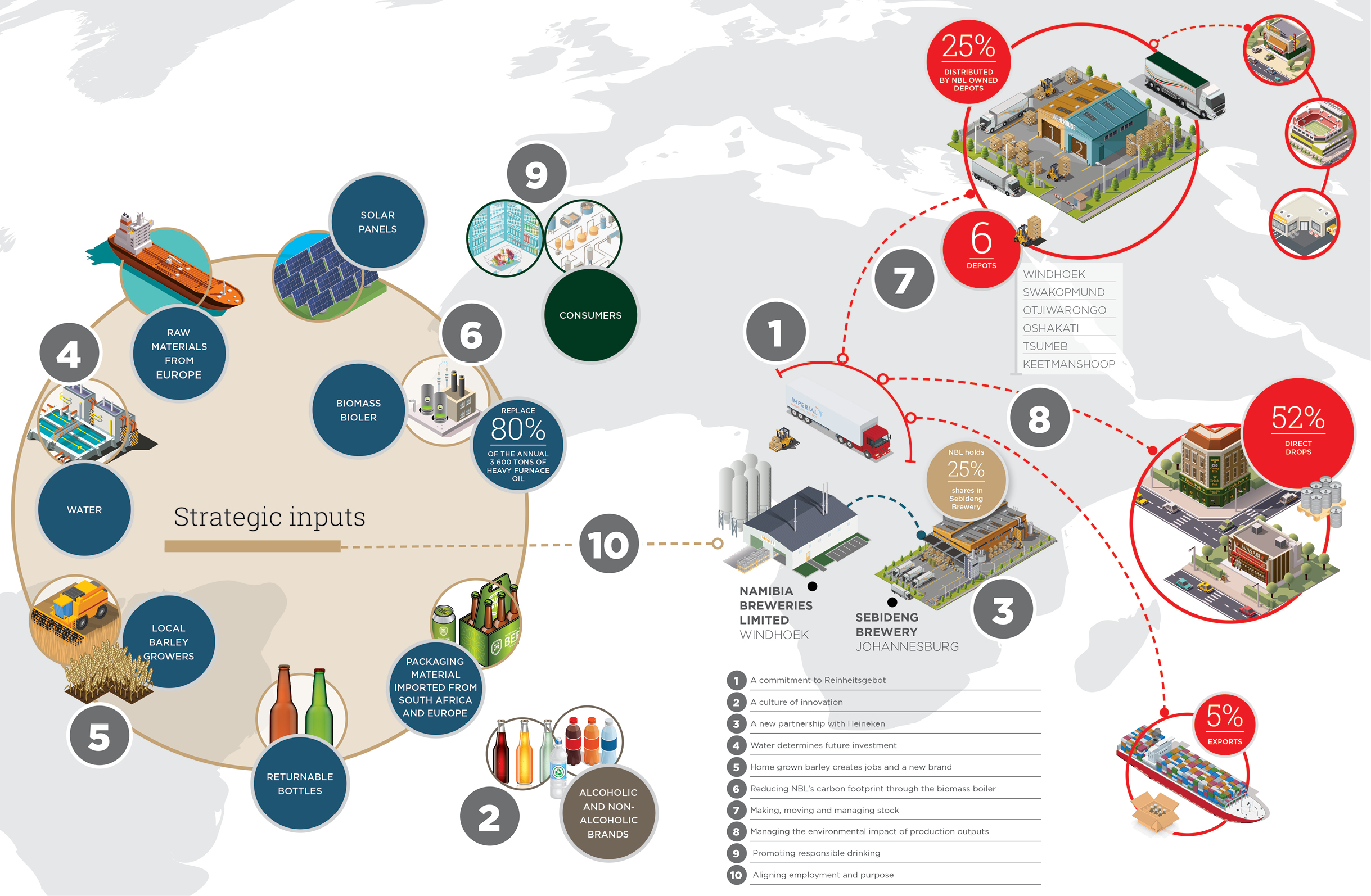
The Namibian Government’s Ministry of Industrialisation, Trade and SME Development chose “Growth at Home” as its theme to drive accelerated economic growth, reduce income inequality and increase employment. The theme subsequently became a strategy adopted by Government for implementing Namibia’s first Industrial Policy and to attain the strategic objectives for manufacturing as outlined in the National Development Plan. At its core is strengthening local and national value chains and creating more efficient links through improved logistics and infrastructure, improvements in the ease of doing business and ongoing dialogue and partnership between Government and the private sector.
NBL has been partnering with Government for several years to develop green schemes and contribute to the agricultural sector as a major contributor to its value chain.
In 2015 NBL concluded a tripartite agreement with the Ministry of Agriculture, Water and Forestry, as well as the Agricultural Business Development Agency (AgriBusDev). This followed several years of trials to establish a commercial barley growing venture. The barley is grown as part of Government’s green schemes, which encourage the development of irrigation-based agronomic production in Namibia. The green schemes increase the contribution of agriculture to the country’s GDP and simultaneously achieve social development and upliftment of communities located within suitable irrigation areas.
The barley project started with about 370 hectares under irrigation, predominantly in the Kavango region. NBL has committed to buy all the barley harvested, with a 10-year target of 12 000 hectares. The barley cultivar was sourced from Europe and selected based on local climatic conditions.
With the barley project starting to deliver, NBL has launched its first commercial beer brewed from local barley: King Lager.
Establishing a malting plant is not yet feasible for NBL, due to the current small volumes of locally produced barley. The local barley is therefore used as an unmalted ingredient to produce King Lager.
In addition to a new unique brand for NBL, the barley project is expected to create an additional 2 500 Namibian job opportunities over a 10‑year period – a major contributor to the Group’s vision of creating 4 000 additional job opportunities by 2019.
Barley is also an ideal complementary crop for established and commercial farmers as it is grown according to a different seasonal cycle than food crops.
NBL currently imports approximately 30 000 tons of malted barley per annum, mainly from Europe, with malted barley being a key ingredient for all its beer brands. Since commencement of the barley trials NBL, in partnership with O&L Group, has invested a significant amount in trial planning, execution, seeds, laboratory and brewing trials, shipments and logistics. This amount excludes the product innovation work that has gone into developing King Lager.
|
NBL has been partnering with Government for several years to develop green schemes and contribute to the agricultural sector as a major contributor to its value chain. |
